
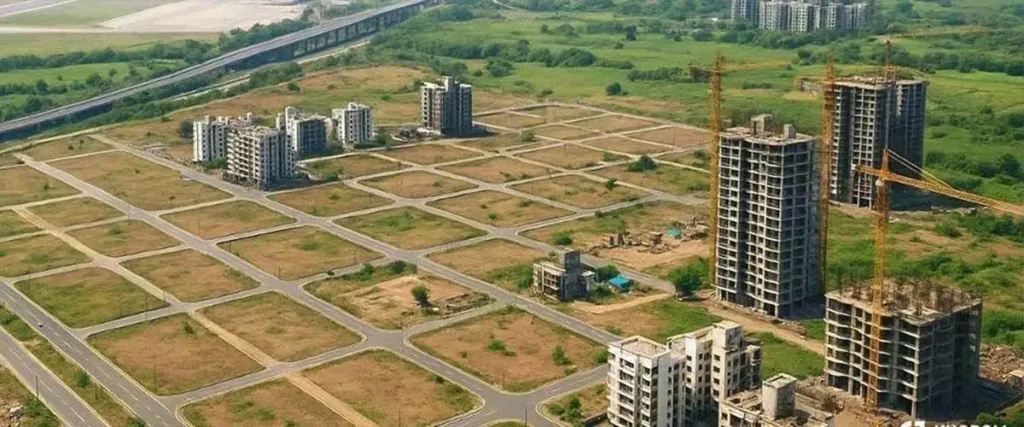
The global economic gravity is shifting, and the epicenter has been identified: India’s 100-Acre Innovation District rising adjacent to the Navi Mumbai International Airport (NMIA). This is not merely a real estate development; it is India’s first large-scale, “plug-and-play” technology ecosystem designed to rival global hubs like Silicon Valley and Shenzhen. Announced at the World Economic Forum 2026, this district represents a monumental $11 billion commitment led by the Tata Group in collaboration with the Government of Maharashtra.
Why an “Innovation District” Now?
While traditional business districts focus on commercial office space, an Innovation District integrates research, startups, academia, and global corporations into a dense, walkable, and hyper-connected urban fabric. India’s 100-Acre Innovation powerhouse is the crown jewel of the “Third Mumbai” initiative, strategically positioned within the Navi Mumbai Airport Influence Notified Area (NAINA).
The objective is clear: to transition Mumbai from a financial capital to a global technology and manufacturing powerhouse. By focusing on high-impact sectors like Artificial Intelligence (AI), Semiconductors, and Global Capability Centers (GCCs), this district is set to generate over 3 million jobs, fundamentally altering the real estate demand-supply dynamics of the Mumbai Metropolitan Region (MMR).
The $11 Billion Catalyst
The backbone of this innovation corridor is the massive capital infusion from Tata Sons, aimed at building a future-ready digital infrastructure.
- AI & Humanoid Robotics: The district will host India’s most advanced high-performance computing platforms and research labs for humanoid automation.
- Semiconductor Ecosystem: With global supply chains diversifying, this hub provides the “plug-and-play” infrastructure required for semiconductor design and testing.
- Next-Gen Data Centers: To support the AI revolution, a series of sustainable, liquid-cooled data centers are being integrated directly into the 100-acre master plan.
The Connectivity Multiplier
The value of any innovation hub is defined by its accessibility. The India’s 100-acre Innovation District is the best-connected land parcel in India, benefiting from a multi-modal transit network:
- Navi Mumbai International Airport (NMIA): Located less than 10 minutes away, providing global executives with instant “fly-in, fly-out” convenience.
- Atal Setu (MTHL): Connecting the district to South Mumbai in under 20 minutes, effectively merging the old financial world with the new tech world.
- Mumbai-Pune Expressway: Positioning the hub as the bridge between Mumbai’s capital and Pune’s IT talent pool.
- Upcoming Coastal Road & Metro Line 4: Ensuring seamless intra-city mobility for the millions of professionals who will call this region home.
Micro-Market Impact: The Growth of NAINA & Beyond
This project acts as a magnet for peripheral growth. Surrounding micro-markets like Panvel, Ulwe, and Kharghar are no longer just residential suburbs; they are becoming essential support ecosystems for the Innovation District. Investors are already eyeing residential projects by Tier-1 developers like House of Abhinandan Lodha, who specialize in strategic land parcels that capture this specific “infrastructure-led” appreciation.
The Business Case for 2026
For the savvy investor, the India’s 100-acre Innovation District is a “Once-in-a-Generation” opportunity. Here is why:
- Unmatched Appreciation: Historically, properties near global airports and innovation hubs see 3x higher capital appreciation compared to standard residential zones.
- High Rental Yields: The influx of high-income tech professionals will drive demand for premium “walk-to-work” housing, pushing rental yields to an estimated 6-8%.
- Legal & Scalable Growth: Being a government-backed initiative under CIDCO and NAINA, the district offers a level of legal transparency and master-planned infrastructure that is rarely seen in Indian real estate.
A Model for Future Cities
This 100-acre district isn’t just about tech; it’s about a superior quality of life. The master plan includes:
- Circular Economy: Integrated waste-to-wealth systems and smart water management.
- Green Buffers: 30% of the land is dedicated to open green spaces, urban forests, and pedestrian-only zones.
- Smart Living: 5G-enabled infrastructure, AI-monitored traffic systems, and EV-exclusive transit corridors.
Securing Your Piece of the Future with India’s 100-Acre Innovation
India’s first large-scale innovation district near the Navi Mumbai Airport is the ultimate validation of the “Third Mumbai” dream. As the Tata Group and the Maharashtra government break ground on this 100-acre marvel, the window for entry-level investment is closing. Whether you are a global corporation seeking a GCC base or an individual investor looking for the next growth frontier, this district is where the future of India is being built.
Everything You Need to Know
- What is the 100-acre Innovation District?
It is a specialized technology hub near Navi Mumbai Airport focusing on AI, semiconductors, and global innovation research.
- Who is the primary developer?
The project is a strategic collaboration between the Government of Maharashtra and the Tata Group ($11B investment).
- How will it affect real estate in Navi Mumbai?
It is expected to trigger a significant surge in property prices in Panvel, Kharghar, and the NAINA region due to high job creation.
- When will the district be operational?
Infrastructure work has commenced in early 2026, with the first phase expected to be functional by late 2027.
Experience the Future with HoABL
At HoABL, we identify these high-growth corridors before they hit the mainstream. Our projects near the Navi Mumbai Airport Influence Zone are designed to offer you front-row seats to this economic revolution.
Ready to invest in the future of Third Mumbai? Call our Investment Experts: +91 7888091619 Visit Our Sales Gallery: www.hoablindia.com/projects/hoabl-thane